
Why Every Foreign Divorce Involving an Indian Marriage Requires Cross-Border Legal Advice From the Beginning
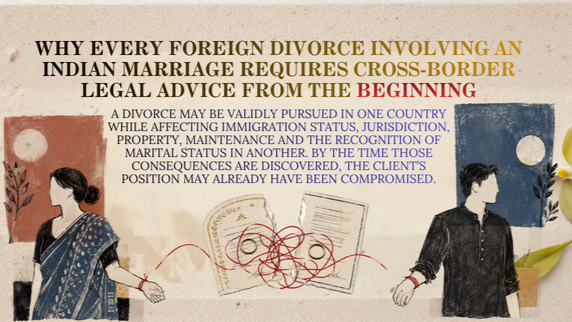
When income, investments or property move between two countries, nobody questions the need for a cross-border tax specialist.
A domestic accountant may be excellent at what they do. But if the client earns in one country, owns property in another, transfers money internationally and has legal obligations in both, we understand that knowledge of one tax system is not enough.
Yet we do not apply the same caution when a marriage crosses borders.
Two Indian citizens may marry in India under Indian matrimonial law, move abroad on employment and dependent visas, earn money in one country, purchase property in another, have children with connections to both and remain legally, financially and culturally tied to India.
When the marriage breaks down, however, the matter is frequently treated as an ordinary domestic divorce in whichever country the couple is temporarily residing.
That is where the problem begins.
The foreign lawyer may know the law of that country/state perfectly. The Indian lawyer may know India's matrimonial law perfectly. An immigration lawyer may understand the visa consequences. An NGO may provide shelter, protection, and legal assistance to an abused spouse. Everyone may be acting competently and with the best intentions.
But unless someone is examining how every decision in one country will affect the client in the other, nobody is advising on the complete case.
Cross-border capital receives coordinated advice because financial consequences matter. A cross-border family, involving immigration status, children, maintenance, property, marital status and an entire future, deserves at least the same level of care.
A court may have jurisdiction abroad, but that is not the end of the inquiry.
Similarly, a marriage solemnized in India does not automatically mean that only an Indian court can ever grant a divorce.
If the parties satisfy the jurisdictional requirements of a foreign country, a court there may be entitled under its own law to entertain the divorce. Depending on the country, jurisdiction may be based on residence, domicile or another prescribed connection.
The foreign court’s authority to grant a divorce under its own law and India’s recognition of that divorce are two different legal questions.
For Indian purposes, the court may still need to examine the law under which the marriage was solemnized, the parties’ domicile and residence, the ground upon which the divorce was granted, the foreign court’s competence, the manner in which the respondent participated and whether the proceedings complied with natural justice.
Section 13 of the Code of Civil Procedure provides that a foreign judgment is generally conclusive as to matters directly adjudicated between the parties, subject to important exceptions. A foreign judgment may not be treated as conclusive where:
These are not technical loopholes. They determine whether a foreign judgment will be accepted as conclusive in India as per Sections 13 and 14, Code of Civil Procedure, 1908.
The Supreme Court of India dealt specifically with foreign matrimonial decrees in Y. Narasimha Rao v. Y. Venkata Lakshmi, (1991) 3 SCC 451. The decision remains central to examining the competence of the foreign court, the ground on which the decree was granted, and the nature of the respondent’s submission to the foreign jurisdiction.
This does not mean that every foreign divorce involving an Indian marriage is invalid. It means that obtaining a divorce abroad and ensuring that the decree produces the intended consequences in India are not necessarily the same exercise. That distinction should be examined before the foreign proceeding begins, not after the decree has already been entered.
The first response can shape the case in both countries
A dependent spouse receives foreign divorce papers and becomes frightened.
They are living in an unfamiliar country. Many, but not all, may have no independent income, no knowledge of the legal system, and no family nearby. Their visa may depend upon the spouse who has filed for divorce.
The immediate advice is usually: “Do not ignore the papers. File a response.”
That may be entirely sensible under the foreign country’s procedural law. Nobody should casually allow a default judgment to be entered against them.
But the form and substance of that response require cross-border consideration.
Was jurisdiction challenged or accepted? Was the appearance limited or unconditional? Did the spouse contest the petition on its merits? Did the spouse agree to a ground of divorce that does not exist under the matrimonial law governing the marriage? Was the spouse’s participation truly voluntary and effective? Did the spouse understand how that participation might later be characterized in India? Were both parties made aware of cross-border complexities and jurisdiction?
Merely responding out of fear should not automatically be equated with informed acceptance of every jurisdictional proposition. But if the issue is not identified and preserved properly, the client may later face an argument that they voluntarily submitted to the foreign court.
This is why cross-border counsel must be involved before the first substantive response, stipulation or settlement is filed.
The purpose is not to tell a person to ignore the foreign proceeding. It is to ensure that the response protects the client locally without unnecessarily compromising the client’s position in India.
By the time many clients reach us, they have already participated for months, signed documents, accepted particular language, or allowed important objections to pass. We are then asked to repair a conflict that could have been managed at the beginning.
Preventing that conflict is far more effective than litigating its consequences later.
Divorce can create an immigration advantage that has nothing to do with the merits of the marriage
For a spouse living abroad on dependent immigration status, divorce is not merely the termination of a personal relationship.
It may also terminate the legal relationship upon which that person’s ability to remain in the country depends.
Consider two Indian citizens who marry in India. One receives an employment-based visa abroad. The other accompanies that spouse as a dependent.
The dependent spouse may have no independent status, limited or no authorization to work, little access to money, and no control over the documents used to maintain their immigration status.
If the principal spouse files for divorce, the effect may extend far beyond family law. Once the divorce becomes final, the dependent spouse may no longer qualify for status based on the marital relationship and may have to obtain an independent immigration option or leave the country.
USCIS, for example, recognizes that, in several immigration contexts, a final divorce ends the qualifying spousal relationship. The precise consequences depend upon the immigration category and the person’s individual circumstances. USCIS Policy Manual on marriage and divorce.
In some cases, this consequence is incidental. In others, the immigration imbalance is understood and used deliberately.
One spouse remains abroad with employment, income, housing, access to records and the practical ability to attend court. The other may be required to return to India and continue litigating from thousands of miles away, dependent on others without any understanding or voice.
At that point, saying that both spouses technically had access to the same court does not fully describe the reality.
One could remain beside the courthouse. The other may no longer have been legally or financially able to remain in the country.
A family court may have jurisdiction to grant a divorce, but it does not necessarily control the immigration consequences of its decree. Nor will every family lawyer be trained to identify the immigration relief, change-of-status options or protections that should be considered before the divorce becomes final.
For qualifying abused non-immigrant spouses, certain independent protections may be available, including employment authorization under Form I-765V in specified circumstances. Other protections may exist where the abusive spouse is a US citizen or permanent resident. These remedies are category-specific and require immigration advice based on the individual facts. Every country has its own laws and can be discussed on a case to case perspective.
The immigration review cannot be postponed until after the divorce. In many cases, timing is the entire issue.
A foreign decree can end the marriage abroad without resolving the client’s position in India
A spouse may receive a final foreign decree and reasonably believe that every legal issue connected with the marriage has ended.
That assumption can be dangerous.
The decree may unquestionably terminate the marriage in the country where it was granted while still facing questions of recognition or legal effect in India.
If the foreign decree is later found not to be conclusive for Indian purposes, questions can arise concerning remarriage, succession, maintenance, marital status and other continuing rights and obligations.
In some but not all times unrecognized foreign divorce automatically creates bigamy. The answer will depend on the validity and recognition of the first decree, the law governing the marriage, the place of any subsequent marriage and the applicable criminal and matrimonial law.
But the possibility of conflicting marital status is serious enough that no client should be advised to remarry without examining how the foreign divorce will be treated in India.
The same applies to financial relief.
A foreign court may dissolve the marriage while lacking effective authority over Indian immovable property. It may determine support but leave the spouse with the separate problem of recognition and enforcement. It may enter custody orders that become difficult to implement after a child or parent returns to India.
A decree is not self-executing throughout the world merely because it is valid where it was issued.
“Reciprocating territory” does not answer every foreign-divorce question
The concept of a reciprocating territory is frequently misunderstood in these cases.
Under Section 44A of the Code of Civil Procedure, a qualifying money decree from a notified superior court of a reciprocating territory may be filed and executed in India as if it had been passed by an Indian district court. Even then, execution may be refused if the judgment falls within one of the exceptions under Section 13.
Section 44A defines the relevant decree as one under which a sum of money is payable, subject to specified exclusions. It is therefore principally an execution mechanism for qualifying money judgments. Section 44A, Code of Civil Procedure, 1908.
It should not be treated as a universal rule automatically validating or invalidating foreign divorces.
Where a judgment comes from a non-reciprocating country, direct execution under Section 44A is not available. A fresh proceeding based on the foreign judgment may ordinarily be required for the relevant monetary claim, subject to limitation, jurisdiction and the Section 13 requirements.
But recognition of matrimonial status, enforcement of a money award, child custody, maintenance and rights concerning Indian immovable property are distinct questions. They may involve different statutes, procedures and jurisdictional tests.
It is therefore not enough to ask, “Is this country reciprocating?”
The proper questions are: What part of the foreign order is being relied upon? Is the party seeking recognition of marital status or execution of a monetary obligation? Which court issued the order? What law governed the marriage? Was the decree given on the merits? How did the other spouse participate? What assets or persons are located in India?
Cross-border family law cannot be reduced to one list of reciprocating and non-reciprocating countries.
One divorce may contain several separate jurisdictional problems
Another common mistake is to assume that whichever court hears the divorce should decide everything connected with the family.
That is not necessarily how international family disputes operate.
Jurisdiction over marital status may be based on residence or domicile.
Child-custody jurisdiction may depend upon the child’s habitual residence, home state, welfare and existing proceedings.
Maintenance may require personal jurisdiction and later enforcement where the paying spouse’s income or assets are located.
Indian immovable property raises separate questions of title, territorial jurisdiction and enforceability.
Immigration status is determined under the relevant country’s immigration law, not by the family court.
Domestic violence proceedings may involve emergency jurisdiction and protective relief as per the law of the land and as per the law of the citizenship country.
Criminal allegations may be investigated and prosecuted independently of the divorce.
This means one court may have jurisdiction to dissolve the marriage without possessing effective authority over every related issue.
International child-custody cases involving India carry an additional complication. India is not currently a contracting state to the 1980 Hague Convention on the Civil Aspects of International Child Abduction. The treaty’s return mechanism therefore does not operate between India and a contracting country in the same manner as it does between two contracting states. HCCH information on the 1980 Child Abduction Convention.
Custody strategy must consequently be considered separately and at the earliest possible stage. It cannot simply be treated as another paragraph in the divorce petition.
The Indian property that never appears in the foreign divorce
Many Indian families living abroad continue to build assets in India.
Money earned in the United States, Canada, Australia, Dubai, Qatar, New Zealand, the United Kingdom or another country may be transferred to parents in India. It may be used to purchase a house, land, investments or other property. Title may be placed in a parent’s name with an informal understanding that the asset will eventually benefit the couple or their children.
When the marriage breaks down, the dependent spouse may know that money was regularly sent to India but may not have access to bank statements, title records or details of the transaction.
The foreign lawyer may correctly identify earnings acquired during marriage as marital or community property under local law. But characterization of the money does not automatically determine title to property standing in the name of a third party in India.
The matter may require tracing international transfers, studying the source of funds, examining whether the payment was a gift, loan, investment or concealment of marital assets, obtaining Indian land records and assessing whether the parents or other titleholders must be joined in separate proceedings.
The foreign lawyer may understand financial disclosure and marital-property principles but not Indian title law. The Indian advocate may understand the property records but not the foreign jurisdiction’s discovery rules or characterization of earnings.
Neither lawyer is necessarily doing anything wrong.
The problem is that each sees only one side of the asset.
A cross-border advisor coordinates the inquiry before records disappear, limitation issues arise or the foreign case concludes without addressing property that should have been investigated.
The unintended gap in NGO and legal-aid assistance
This problem also affects NGOs and legal-aid organizations assisting battered and dependent spouses.
Many of these organizations do exceptional work. They arrange emergency shelter, obtain protective orders, provide counseling, connect survivors with immigration services, and help them access family courts they could never otherwise afford.
They intend to protect vulnerable people, and that contribution should not be minimized.
The concern is that many do not have an India-focused cross-border family-law advisor on their board or referral panel.
An Indian spouse may therefore receive immediate protection in the foreign country without being advised how responding to divorce proceedings, consenting to particular language, signing a settlement or allowing a decree to become final could affect matrimonial rights, property, maintenance, immigration status and recognition of the decree in India.
I have spoken with Indian women who received genuine help from such organizations but later felt that some of their most important cross-border rights were never explained. Their disappointment can become so intense that they want to sue the organization that assisted them.
At that stage, one of the most difficult conversations is explaining that an unfavorable outcome does not automatically create a viable legal claim, particularly when the organization acted in good faith and within the limits of its expertise. If the person nevertheless insists on exploring litigation, counsel may have to assess and prepare the claim, although litigation against organizations serving vulnerable spouses is an outcome nobody should want.
The better solution is prevention.
NGOs do not need to become experts in Indian law. Domestic-violence lawyers do not need to practise in two countries. But their intake and referral systems should identify when a marriage, immigration status, child, asset or pending proceeding has a substantial Indian connection.
At that point, cross-border consultation should become part of the assistance being offered.
Without that referral, compassionate help may protect a person from today’s emergency while unintentionally leaving them exposed to years of litigation across two countries.
Recognizing this gap is not an attack on NGOs. It is an invitation to strengthen the protection they already provide.
What cross-border counsel contributes to the case
A cross-border family-law advisor is not retained to replace the locally licensed divorce lawyer, immigration lawyer or Indian advocate.
The role is to ensure that their work is coordinated.
Before the first response or settlement, the advisor should be examining:
This is not duplicate representation. It is legal coordination.
The cross-border advisor may not appear as counsel of record in the foreign court. The advisor may instead work with locally licensed counsel, identify Indian-law consequences, prepare an expert opinion, help preserve jurisdictional issues, coordinate Indian proceedings and ensure that the client understands what a proposed action will do on both sides of the border.
The point is not that one country’s law is superior to another.
The point is that neither country’s domestic law, viewed alone, can describe the client’s entire legal reality.
Why the advice must come at the beginning
In our practice, we repeatedly see matters involving the United States, Canada, Australia, New Zealand and other jurisdictions only after the foreign proceeding has substantially progressed.
By then, the client may have:
At that stage, the work becomes an attempt to repair the case.
The client must spend more money, engage lawyers in multiple jurisdictions and litigate questions that could have been addressed before the first foreign filing.
A cross-border advisor should not be the professional called after both legal systems have produced conflicting results.
The advisor should be involved before a response is filed, before jurisdiction is accepted, before the divorce becomes final and before the dependent spouse loses the practical ability to remain and litigate in the foreign country.
Cross-border families deserve the same seriousness as cross-border capital
Nobody expects a domestic accountant to advise on the tax law of every country. We recognize the limit of one-jurisdiction knowledge and bring in a specialist before making decisions.
Family lawyers, immigration lawyers and NGOs should be given the same professional space to seek cross-border assistance.
Consulting an advisor who understands the Indian consequences is not an admission that local counsel cannot handle the case. It is an acknowledgment that the case extends beyond the local lawyer’s jurisdiction.
Clients must also reconsider how they value this advice.
People willingly pay specialists to protect international businesses, overseas investments and foreign property. But when advised to obtain a cross-border family-law opinion, they may treat it as an unnecessary additional expense.
If families truly matter more than capital, our legal planning should reflect that belief.
A mistake in an international financial transaction may cost money.
A mistake in an international family case can cost a person their immigration status, home, financial security, relationship with their children, ability to participate in court and certainty about whether the marriage has been legally and conclusively dissolved.
The foreign judge may not be wrong. The Indian judge may not be wrong. The local lawyer may not be wrong. The NGO may not be wrong.
The failure occurs when every professional handles the part visible from within their own legal system and nobody is responsible for seeing what happens to the client across the border.
That is why cross-border counsel is not an optional addition to an international divorce.
When an Indian marriage, foreign residence, dependent immigration status, children and assets exist across more than one country, cross-border advice is part of competent planning from the beginning.
Not after the decree.
Not after the spouse has lost status.
Not after the client has returned to India.
And not after the case has already become two different legal battles in two different countries.
This article provides general legal information and does not substitute for advice based on individual facts. Jurisdiction and available remedies depend on the applicable matrimonial law, the parties’ citizenship, domicile and residence, immigration status, location of children and evidence, and any proceedings pending in India or abroad.
Chavda Law Associates, cross-border counsel for NRI and international matters.