
Muskan’s Death Sentence: Her Infant Daughter’s Liberty, Parentage, and Future Care
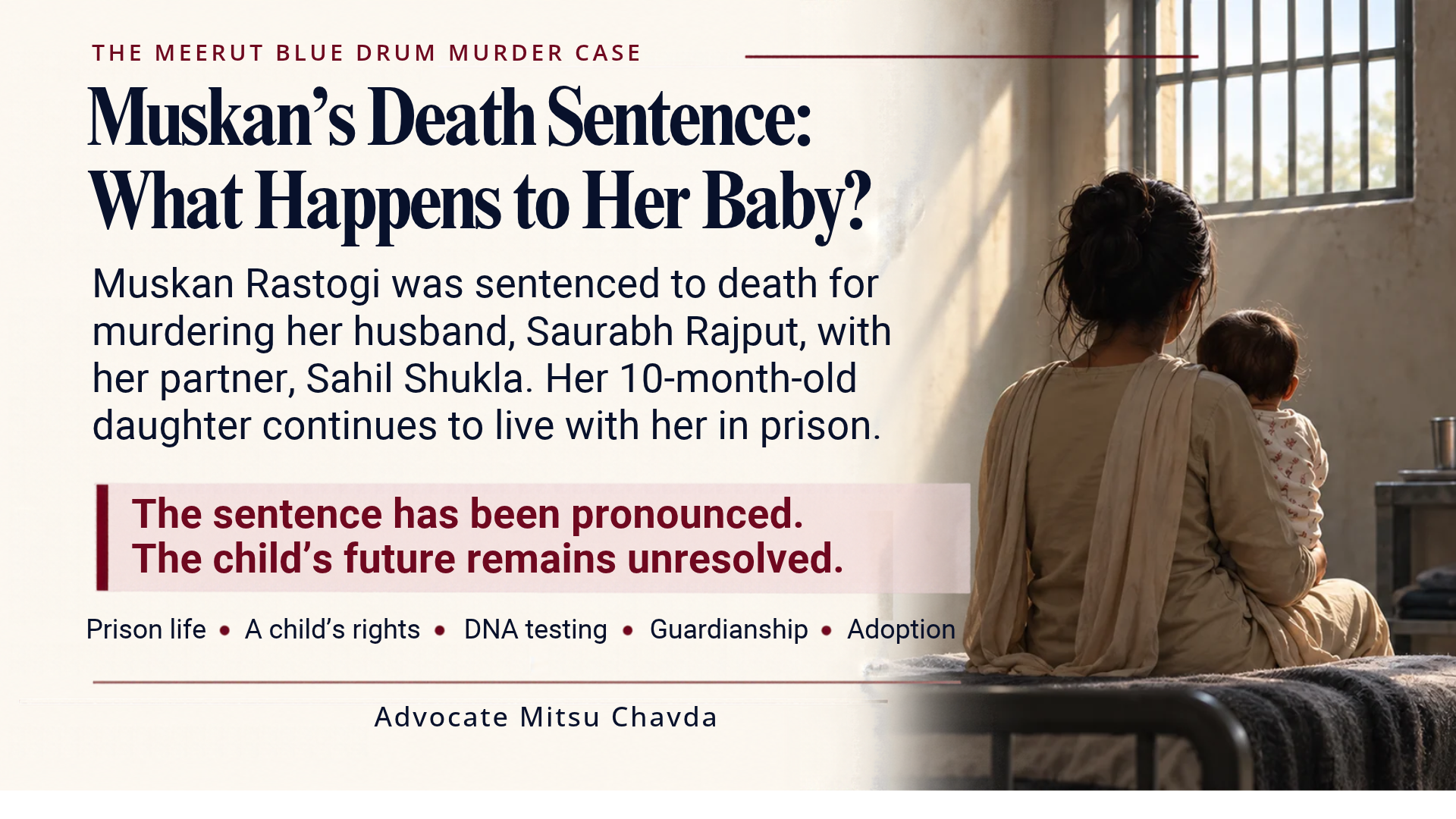
A death sentence answers the trial court’s question about punishment. It leaves a different question unanswered for the infant living with the convicted mother: who is planning for her future?
According to reports following the Meerut court’s sentencing of Muskan Rastogi and Sahil Shukla on 14 October 2026 for the murder of Muskan’s husband, Saurabh Rajput, her approximately ten-month-old daughter continues to live with her in prison. Reports also record requests from Saurabh’s family for DNA testing. The material reviewed does not establish a final judicial determination of the infant’s biological parentage or long-term care.
The child’s circumstances deserve consideration independently of the criminal proceedings. She has her own rights to life, personal liberty and dignity under Article 21. Those rights require attention while her mother’s case proceeds through the courts.
In my view, three matters warrant action now: an individual assessment of the child’s living arrangements, a properly supported application for judicial resolution of disputed parentage, including DNA testing, and a care plan that can provide continuity if her mother becomes unable to look after her.
A childhood within prison walls
The legal permission for children to remain with incarcerated mothers until six is frequently treated as a complete answer to their situation. It provides an age limit. It does not resolve whether a particular arrangement adequately serves a particular child.
In R.D. Upadhyay v. State of Andhra Pradesh , decided on 13 April 2006, the Supreme Court recognised the difficulties faced by children living in prison with their mothers. It directed that they must not be treated as prisoners and required provision for their care and development. The Court permitted children to remain until six and addressed alternative placement and continued maternal contact afterwards.
The underlying difficulty remains. A child may be legally free of any accusation while experiencing a daily life organised around prison restrictions. Access to other caregivers, ordinary social environments and opportunities for development may depend on arrangements made by the prison administration.
Article 21 and the constitutional commitment in Article 39(f) to childhood development in conditions of freedom and dignity provide grounds for examining those arrangements closely. This does not make every instance of a child accompanying a prisoner unlawful detention. It does mean that the child’s welfare cannot be presumed merely because residence is permitted.
An assessment should consider the actual facilities available, the infant’s health and development, her caregiving relationship with her mother, and whether a suitable arrangement outside prison exists. General concerns about prison conditions should prompt that inquiry without becoming an unsupported diagnosis of this child.
Attachment and the possibility of separation
Maternal attachment cannot be dismissed because the mother has been convicted of a serious crime. For an infant, the person providing daily care may be central to her sense of security. Separation therefore requires careful assessment.
At the same time, authorities must prepare for changes in that relationship. The concern is an abrupt, unplanned loss of the child’s principal caregiver, whether caused by a change in placement, the age limit for prison residence or an eventual execution.
Execution is not an inevitable consequence of the trial court’s sentence. Section 407 of the BNSS requires High Court confirmation before a Sessions Court’s death sentence can be executed. Further judicial remedies and constitutional mercy proceedings may also affect the outcome.
That uncertainty gives the authorities a reason to prepare for several outcomes. It provides no sound reason to postpone planning until an execution date is fixed.
A child-development professional should help assess any proposed transition. Where appropriate, suitable relatives or other authorised caregivers could be introduced gradually, with continued maternal contact considered in accordance with the child’s welfare and applicable orders. R.D. Upadhyay already recognises the importance of contact after alternative placement. The additional proposal here is an early, reviewed plan addressing the particular uncertainty surrounding a capital sentence.
Why DNA testing should be sought
I support seeking court-directed DNA testing through properly constituted proceedings concerning the child’s parentage and legal rights.
The reported circumstances make the question consequential. The mother and her partner have been sentenced for killing her husband, and members of the deceased husband’s family have reportedly linked their willingness to assume responsibility to biological parentage. Their statements explain the dispute; they cannot determine its legal outcome.
Neither the conviction nor the relationship establishes who fathered the infant. Equally, a family’s uncertainty does not mean that the child has no existing legal protection concerning parentage.
Section 116 of the Bharatiya Sakshya Adhiniyam protects the legitimacy of a child born during a valid marriage or within 280 days after its dissolution, the mother remaining unmarried, subject to the statutory exception concerning non-access. On the reported chronology, the birth on 24 November 2025 falls within 280 days of Saurabh’s death in early March. The provision therefore requires express examination, subject to verification of the relevant facts and conditions.
A persuasive application must address that protection directly. It should identify the concrete legal issue requiring determination, the existing evidence and why that evidence cannot adequately resolve the dispute. It must also explain why testing is necessary and proportionate.
The Supreme Court’s caution is substantial. In Aparna Ajinkya Firodia v. Ajinkya Arun Firodia , decided on 20 February 2023, the Court rejected mechanical resort to a child’s DNA test and examined the statutory protection, non-access, privacy and the consequences for the child. Allegations of infidelity do not, by themselves, remove those safeguards.
The argument here should concern the child’s identity and specific legal interests, including any material questions of family placement, maintenance or succession. Describing the case as unusual cannot replace the required legal foundation.
Recent authority also distinguishes between ordering a test and deciding the effect of a report already available. In Nikhat Parveen v. Rafique, 2026 INSC 399 , the Supreme Court considered an existing DNA test conducted with consent whose conclusion remained undisputed. It upheld the denial of the child’s maintenance claim against the respondent while separately directing an assessment of the child’s welfare. The judgment illustrates why biological clarification cannot simply be assumed to improve a child’s legal position.
My position remains that an application should be pursued if the verified facts provide the necessary foundation. It should include appropriate representation of the infant’s interests and safeguards governing sampling, forensic reliability and disclosure. A negative result concerning one man would not, by itself, establish that another man is the father. Throughout that process, the child’s immediate care must continue. Protection cannot depend on a test result.
Who can legally care for her?
Parentage, physical custody and guardianship are related but distinct questions.
A biological relationship does not automatically establish that a person is suitable to raise the child. Conversely, a suitable maternal relative need not be excluded from consideration while paternal parentage remains disputed.
Section 17 of the Guardians and Wards Act requires consideration of the minor’s welfare, including the proposed guardian’s character, capacity and relationship with the child. Section 13 of the Hindu Minority and Guardianship Act, where applicable, makes welfare paramount. Any proposed appointment must also address section 19 of the Guardians and Wards Act. It restricts appointment of another guardian of the person where a living father or mother is not, in the court’s opinion, unfit. A death sentence does not itself appoint a substitute guardian or automatically extinguish parental status.
The appropriate authority must therefore distinguish an arrangement for daily care, a protective placement and a formal guardianship order. The assessment should address safety, stability, willingness to provide care and the ability to protect the child from hostility associated with the case.
It should also establish who can lawfully make decisions about medical treatment, education and documentation, and who will protect any property or financial interests belonging to her. An informal understanding among adults may leave those responsibilities uncertain.
What happens when no suitable relative comes forward?
Where the circumstances bring the child within the Juvenile Justice Act’s framework for children needing care and protection, the Child Welfare Committee should undertake the required inquiry and determine an appropriate arrangement. Available measures can include a fit person, foster care or a registered child-care institution, with institutionalisation treated as a last resort.
The expression “ juvenile home ” is imprecise here. This infant has committed no offence. Her needs concern care, protection and rehabilitation, which involve a different legal framework from proceedings concerning children in conflict with the law. Any institutional placement should be accompanied by a reviewed plan for stable care. Placement alone does not resolve the question of upbringing.
When adoption becomes an option
A parent’s imprisonment or death sentence does not automatically make a child available for adoption.
Under the Juvenile Justice framework, the applicable surrender or inquiry process and declaration that an eligible child is legally free for adoption must precede placement for adoption. The prescribed process then culminates in an adoption order from the District Magistrate. The relevant parental rights and statutory safeguards cannot be bypassed because a prospective family is willing to help.
Adoption under the Hindu Adoptions and Maintenance Act, where legally available, involves separate requirements concerning capacity, consent and, in specified circumstances, court permission. Section 56(3) of the Juvenile Justice Act preserves that statutory route.
Guardianship, foster care and adoption should consequently be assessed on their respective legal foundations. None follows automatically from the absence of an immediately available caregiver.
What existing precedent tells us
The broader problem is not without precedent. R.D. Upadhyay provides directions concerning children living with incarcerated mothers. Shabnam v. State of Uttar Pradesh, decided on 15 May 2015, involved capital punishment and a dependent child, although that judgment addressed sentencing rather than the combined questions of disputed parentage, infant placement and guardianship considered here.
The circumstances present an opportunity to seek clearer, coordinated arrangements for dependent children whose principal caregivers face capital punishment. Whether this particular case produces further precedent will depend on the issues properly placed before a court and its decision.
For this infant, the immediate task is practical: assess her circumstances, examine suitable caregivers, obtain the necessary legal orders and resolve any material parentage dispute through lawful proceedings. The plan should remain workable if the sentence is altered, the proceedings continue for years or the mother eventually becomes unable to provide care.
Her childhood is continuing while the criminal process runs its course. The institutions responsible for her welfare must plan on that timescale.
Case-specific facts in this article are drawn from published reporting. The sentencing judgment and any separate parentage or custody orders have not been independently examined.
Chavda Law Associates, cross-border counsel for NRI and international matters.